













Edge Computing in the 5G Era - Why It Is Relevant More Than Ever!
Cloud contact centres help businesses communicate faster, manage read more..

Mumbai
Gurgeon
Noida
Mumbai
Mumbai
Mumbai
Mumbai
Mumbai
Mumbai

Telecoms Supermarket India can help you with clear understanding and business applications of Internet of Things (IoT) Connectivity
Buy now
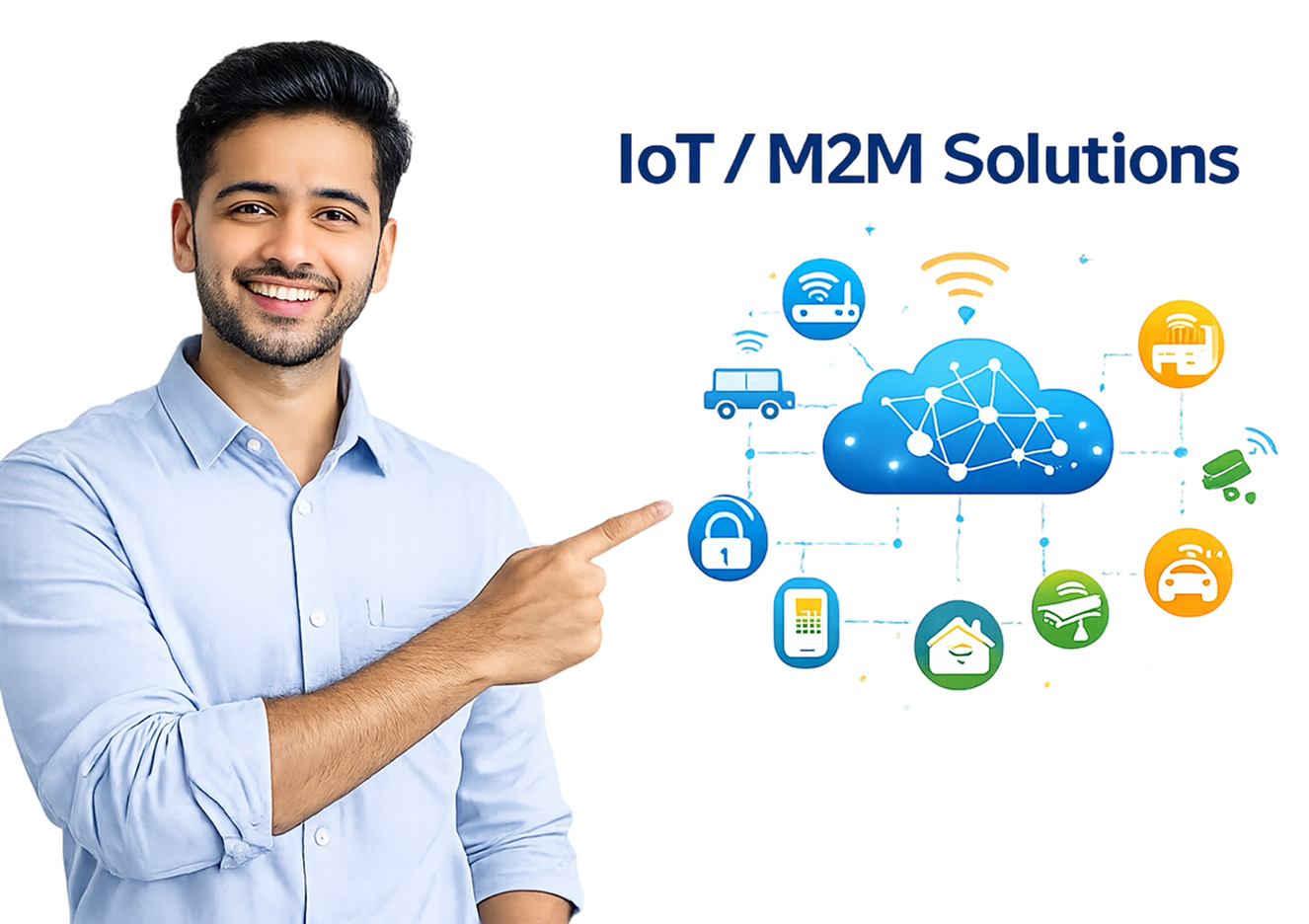
The Internet of Things (IoT) Connectivity is a system of inter-related computing devices, mechanical or digital machines, objects, animals or people that are provided with unique identifiers (UIDs) and the ability to transfer data over a network without requiring any human or computer interaction. The Internet of Things is a pretty simple concept, it means taking all the things in the world and connecting them to the Internet. IoT is a sub-set of M2M.
The IoT has evolved due to the convergence of multiple technologies, real-time analytics, machine learning, commodity sensors, and embedded systems. Technologies like Wireless sensor networks, control systems, embedded systems, automation (including home and building automation), and others contribute to enabling the Internet of Things (IoT) Connectivity. In the consumer market IoT is synonymous with products pertaining to the concept of the "Smart home", covering devices and appliances (such as lighting fixtures, thermostats, home security, cameras, and smart home appliances) that support one or more common ecosystems, and can be controlled via devices associated with that ecosystem, such as smartphones and smart speakers.
The IoT has faced some criticism, especially in regards to privacy and security related to these devices and their intention of pervasive presence but things are changing and people are becoming more receptive with increased security layer.

Internet of Things (IoT) Connectivity system architecture consists of three tiers: devices, the Edge Gateway, and cloud. Devices include networked components, such as the sensors and actuators found in IoT equipment. The Edge Gateway consists of sensor data aggregation, such as pre-processing of the data, securing connectivity to the cloud, the event hub, and in some cases edge analytics. The final tier includes the cloud application built for IoT using the micro-services architecture, which are usually polyglot and inherently secure in nature using HTTPS/OAuth.
Internet of Things (IoT) Connectivity applications -
Machine-To-Machine (M2M) communication as it sounds: two machines communicating or exchanging data, without human interaction or intervention. This includes serial connection, power-line connection, or wireless communications in the industrial IoT. Ability to switch to wireless has made M2M communication much easier and enabled more applications to be connected.
In general, when someone says M2M, they often refer to mobile communication for embedded devices. Examples of M2M can ATM machines authorising to dispense cash
As stated above, M2M makes the Internet of Things possible. M2M is among the fastest growing kinds of connected device technologies in the market as per Forbes right now, largely because M2M technologies can connect millions of devices in a single network. The connected devices include anything from vending machines to medical equipment to vehicles to buildings. Pretty much anything that houses sensor or control technology can be connected to some sort of wireless network.
M2M networks are very much same as LAN or WAN networks, but are exclusively used to allow machines, sensors, and controls, to communicate. These devices feed data they collect back to other devices in the network. This process allows a human (or an intelligent control unit) to assess what is happening across the whole network and issue appropriate instructions to member devices.
Differences Between M2M and the IoT
M2M is a direct communication between devices using wired or wireless communication channels. M2M refers to the interaction of two or more devices or machines that are connected to each other. The devices capture data and share with other connected devices, creating an intelligent network of things. M2M technology could be present in our homes, offices, shopping malls and other places. Ability to control electrical appliances like bulbs and fans using RF or Bluetooth from your smartphone is a simple example of M2M applications at home. Electrical appliance and your smartphone are the two machines communicating with each other.
IoT is the network of devices embedded with sensors and software enabling these devices to communicate with each other and exchange data over a computer network. The components in the IoT refer to hardware devices uniquely identifiable through a network platform within the Internet infrastructure.
IoT and M2M is confusing as both refer to communicating and sharing data. M2M is about machines, smartphones and appliances, whereas the IoT is about sensors, cyber based physical systems, Internet in simple words.
IoT is inherently more scalable than M2M because of its cloud-based architecture. Cloud based architecture removes the need for additional hard-wired connections and M2M SIM card installation.
IoT suffers platform fragmentation and lack of technical standards in both hardware variations and differences in the software running on them making development of applications that work consistently between different inconsistent technology ecosystems hard. For example, wireless connectivity for IoT devices can be done using Bluetooth, Zigbee, Z-Wave, LoRa, NB-IoT, etc with its own advantages and disadvantages, creating a separate ecosystem for IoT devices.
In a nutshell, both technologies enable machines to communicate, collect, store, and exchange data; autonomously make corresponding decisions; and perform tasks with very minimal human intervention. They are different solutions for the enterprise.
Businesses shouldn’t think about Internet of Things (IoT) Connectivity or Machine To Machine (M2M) Connectivity for the sake of IoT or M2M. Instead, the focus should be on optimising business models or providing value for customers. For example, if you’re in a logistics business like DHL or DTDC, you have obvious choices for automated logistics decisions made by machines. But before you move forward with the process, you have to consider the value you’re getting out of it. How much does it cost to implement? Will it actually target the right audience? Will it be effective?
Telecoms Supermarket India can help you with clear understanding and business applications of IoT and M2M, and enhance your business efficiency. Contact them today on 011 42908899.
IoT/M2M Solutions enable devices, machines, and systems to communicate automatically, exchange information, and support intelligent business operations.
M2M focuses on direct communication between devices, whilst IoT extends connectivity by integrating devices with cloud platforms, analytics, and business applications.
Manufacturing, logistics, healthcare, agriculture, utilities, transportation, retail, and smart infrastructure sectors commonly utilise connected device technologies.
Businesses adopt IoT solutions to improve visibility, automate operations, reduce costs, and gain actionable insights from connected assets.
IoT Service Providers deliver connectivity, device management, monitoring platforms, and infrastructure required to support connected ecosystems.
Yes. Modern IoT and M2M platforms are designed to support thousands of connected devices across multiple locations and operational environments.

Discover how IoT/M2M Solutions can help your organisation improve visibility, automate processes, and drive operational excellence.
Talk to an Expert
Latest news, comparisons, and expert insights to help you make smarter connectivity and technology decisions.

Cloud contact centres help businesses communicate faster, manage read more..
Cloud contact centres help businesses communicate faster, manage read more..
Cloud contact centres help businesses communicate faster, manage read more..

Are you looking for business or home solution ?
Home
Business

| Features |
🔥 Most Popular
-
-
-
-
-
|
🔥 Most Popular
-
-
-
-
-
|
🔥 Most Popular
-
-
-
-
-
|
🔥 Most Popular
-
-
-
-
-
|
🔥 Most Popular
-
-
-
-
-
|
|---|---|---|---|---|---|
| Plan Overview | |||||
| Price | - | - | - | - | - |
| Brand | - | - | - | - | - |
| Contract | - | - | - | - | - |
| Package | - | - | - | - | - |
| Internet & Performance | |||||
| Speed | - | - | - | - | - |
| Data Benefit | - | - | - | - | - |
| Usage | - | - | - | - | - |
| Network Type | - | - | - | - | - |
| Calling Benefits | |||||
| Free Calls | - | - | - | - | - |
| Bundled Calls | - | - | - | - | - |
| Overage | - | - | - | - | - |
| Devices & Extras | |||||
| Device | - | - | - | - | - |
| Storage | - | - | - | - | - |
| Package Included | - | - | - | - | - |
| Subscription Pack | - | - | - | - | - |
| Recorder | - | - | - | - | - |